Choice Architecture
How AI Skeptic Professors Can Help Students Want to Learn

I think people liked my essay, “Permission Structures,”1 because I was upbeat and practical in the face of what seems like the irrefragable challenge of AI to teaching writing in higher education. My year-long intro course—and several other courses which used similar concepts operationalized differently—has been finished for several months now, and I have had the opportunity to reflect on what worked (and what didn’t). I have course evaluations from the students in the course I profiled in the original essay, and data on enrolment in the Great Books Program at STU for next year. The numbers are great, which matched my own feelings about the course. And so I think that the experiment was a success.
The reaction to that essay—a number of podcast appearances,2 dozens of emails from grateful or curious faculty from all over the world, a nomination for a major teaching award—showed how top-of-mind the question of writing instruction is right now. But as time has passed, I’ve become a bit worried that I have inadvertently misled people about what else is required to succeed with undergraduate instruction these days beyond thoughtful course design. I mentioned this in the original essay, but I want to emphasize that the approach I championed was implemented alongside a parallel set of additional pedagogical commitments.
It’s not enough just to teach writing in this thoughtful way. The approach worked not only because of what it was, but because of what it represented—namely, earnestness about the purpose of the class, and a demonstrated desire to help them address what they know to be a problem.
And so, if last time, I half-ironically borrowed business-speak to discuss how I changed the “permission structures” around academic honesty and teaching writing , now I’d like to talk about the way I designed the broader “choice architecture” in favour of actual learning in my class.

The Reviews
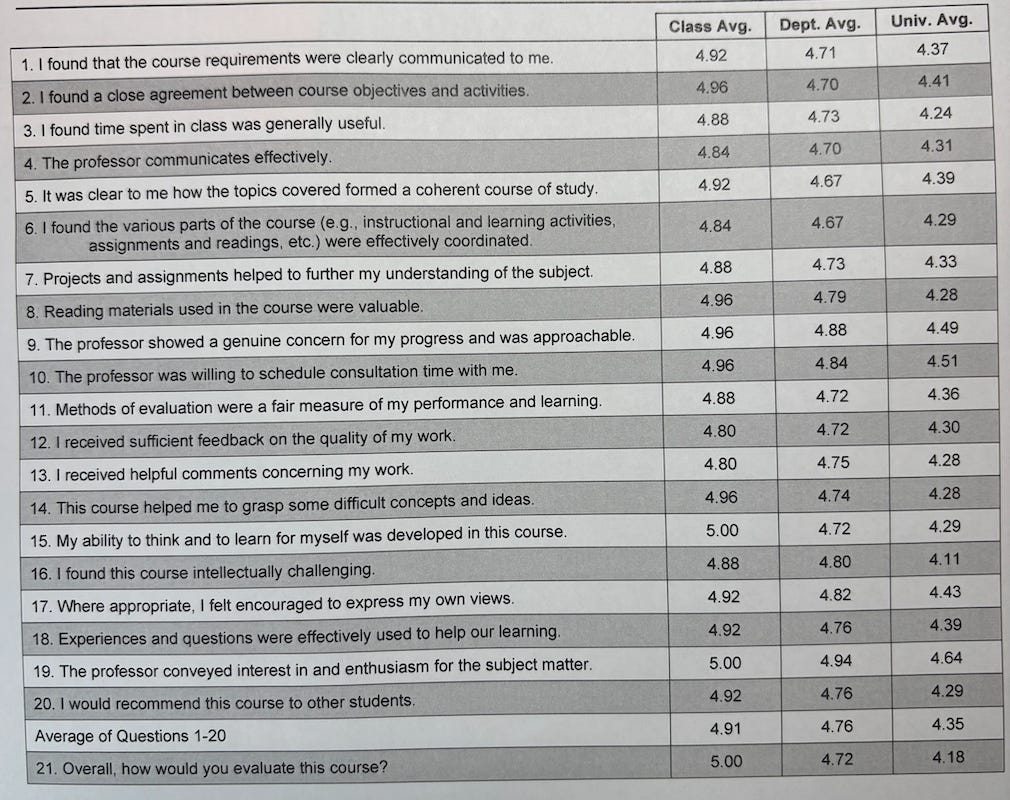
The evaluations for my intro class were excellent. 100% of the students who finished the class rated it 5/5. Moreover, every student indicated that their “ability to think and learn for [themselves] was developed in this course.” Finally, they all also appreciated my enthusiasm. Since these were my emphases for the course, there appears to be rather close alignment between what I wanted for the students, and their own perceptions of about the quality of their learning. I am, of course, aware of the million problems with using course evaluations to assess learning, but when they’re good, they are obviously an authoritative master science, indicative of the actual reality of the classroom in every way.
The lowest scores, which were still quite strong, had to do with quality of feedback. In the qualitative section of the evaluations, a number of the students expressed some frustration with the specifications grading approach I used for about half of their grades, saying they would have preferred to receive traditional grades on their in-class writing assignments at the end of the year. I understand why they’d say that, but, in fact, it’s actually better for them to not get grades on those assignments. I suspect they wanted me to tell them that they were smart and learning a lot, which I did, and that their desire for feedback actually shows that they want praise, not necessarily learning.
In the “Student Views” forms, which are narrative feedback on the course, students acknowledged that the course material was challenging, but also expressed gratitude that I had not only given them a challenge, but helped them meet it. There were also many comments that they appreciated the stable class format: discussion about the readings every day. They knew what to expect, and felt like they could improve on the skill of formulating their thoughts on our readings and sharing them in class because I wasn’t constantly switching things up. I think this shows, to an extent, that part of what worked here is the conversation-based “great books” approach. We were foregrounding very basic questions with great clarity, and our introduction to the great books was centred around the theme of liberal education itself. As someone whose professional career takes place in a great books program, I guess it’s not surprising that I think this is not incidental, but I’m also open to the possibility that a “liberal arts” approach to any subject, which centres basic questions, and emphasizes how these questions matter for their relationship to human lives well-lived will be more successful than one attempting to norm students to a technical or disciplinary language. In this regard, I think most undergraduate teaching should be “pre-disciplinary” because students primarily need to want to learn.
Many of the student evaluations commented on my passion for education, which I think is also required for good teaching. It’s sometimes tempting to attribute good teaching to the charisma of the teacher. I think this is odd, because good teachers are as various as can be, and it seems to me that the best ones share a love of learning rather than some random dispensation of spirit.
In general, there were unusually sophisticated comments on these evaluations. They commented on ideas for re-arranging the furniture in the room for better evaluation, they had ideas for specific assignments, there were more books they wanted to read, they thought about re-ordering some of the readings, and they wanted less of the course to be graded using specifications grading. All of these “complaints” were indicative of them being invested in their own learning, which was my goal.
An additional statistic: Probably the best indicator that the class was a success is that our second-year courses in Great Books at St. Thomas are fully subscribed for next year. This has not happened in my time at STU, and the fact that students are choosing to do something a little weird and difficult shows that the overall approach I took succeeded in helping students appreciate the nobility of difficult things, and to make them want to learn more.
Areas for Improvement
There are two problem areas arising from this class. The first one was that I made it so easy to pass the class, that there were students who were simply not interested in actually doing the reading and coming to class, and instead of simply getting a D, they stopped coming or dropped. This, I think, confirms my entire theory of the case. There wasn’t really the option for a disinterested half-engagement. And if you really feel that way, you won’t want to do a class like mine. Of course, there were also students who had terrible calamities befall them—many of them reached out to me, and I felt very sorry for them, and tried my best to accommodate them, but sometimes life isn’t compatible with being in school, and that’s ok. I lost ten students of sixty by the end of the year. Is there more that I could do as individual faculty member to help with retention? Maybe. I have some ideas for next year.
The other potential problem area was grade inflation. Students in this course did one standard deviation better than in their other courses. Now, there are a few potential explanations for this. One is that I am an easy grader. The second is that the course was too easy. Another is that I “gave away” too much with the specifications grading scheme. Yet another—one that I like because it flatters me—is that I did such a good job teaching them, they did better work for my class than their other classes. Yet another is that they were more engaged and motivated to try hard in my class, which, anecdotally, many of them have indicated is the case. I should probably be a harder grader than I am. This is a well-known problem with teaching at a “high touch” institution. I was, however, genuinely impressed by the work that many of them did on their final examination—closed book essay and passage ID—and maybe I allowed that feeling to inflate the grades I gave on that quite valuable assignment.
But, again, maybe they also just learned a lot.
How I think I managed to create “engagement”
Lesson #1: Is Gen Z Human?
People often talk about Gen Z as if they are space aliens, with inscrutable motives, utterly unlike what older people want. To some, Gen Z is like the squiddish heptapods from Arrival, whose communications can’t be understood without unmooring oneself from one’s usual relationship to linear time. There’s a lot of whining and complaining from faculty about how they can’t read, or have the “Gen Z” stare, or whatever. In lieu of exoticizing our students in this way, I’d instead challenge educators to consider the following question: Is Gen Z human?3
The answer is so obvious as to not really require articulation, but hear me out: if Gen Z is human, they should be treated like human beings, and understood to have regular human motivations. This means assuming that they want regular human things, have human faculties, and can eventually be held to normal human faculties, regardless of what “their world” is like, or how they’ve been raised. Some are ambitious, and some are curious. Some of them are bad and lazy; many are good and hard-working—others fall somewhere in-between. They are not different from us in kind, but in a number of specific and discernible ways, that we can predict, and that have to do with the circumstances of their childhoods.
In North America, their teachers have typically had very low expectations. Nobody reads much, and then there is their immiseration by screens, often from very early childhood. Probably nobody has ever explained that the great inheritance of humankind includes the possibility of wisdom, virtue, prudence, justice, and that universities were once the places where people went in pursuit of learning about such things. I take these things as a given. When I was a student, it wasn’t that different. I had limited access to any cultural world outside of the small town in which I was born and raised. I didn’t know any members of the Greek pantheon, for instance, let alone any Greek, and so The Iliad was pretty confusing at first. But my own professors explained what needed explaining, and, crucially, made it seem not only ok, but expected, to ask questions.
What you know about your university students is that they have agreed to study at a university, which already makes them part of a minority. If they “can’t read,” and you’re a university professor in this year of Our Lord two thousand and twenty-six, have you ever stopped wonder whether they have any reason to want to read? You can’t assume they’re all grasping and careerist, or have had their brains rotted by screens. Ask yourself: why would someone want to spend eight hours per day on tiktok? (or whatever?) There are real human motivations behind a behaviour like that, however strange it might seem to you. And so it’s your job as a teacher to connect with those students on the level of very basic human desires.
On some level, they want to learn, because all human beings reach out with longing toward wisdom. You can gain an awful lot of good will by describing the forces that shape their lives to them in approachable and funny ways, but also then saying: “…and here’s what we’re going to do to help you get where you need to be.”
If Gen Z is human—and they are—then they will respond to normal human motivations, and, luckily, that’s what we humanists, especially, are experts in trying to understand.
Lesson #2: The Importance of Being Earnest
You should understand why you’re teaching what you’re teaching, what basic questions motivate your field of study, and how to couch such concerns in a way that will be attractive to any intelligent undergraduate. That’s a big part of what being a teacher entails. If you do this, and if Gen Z is human, which they are, then they will at least enter a sort of modus vivendi where their interest in getting a grade overlaps with their real, if submerged, desire to know things.
Being upfront, practical, and humane about the AI Issue earned me a lot of good will from the students from the get-go. I was sympathetic to the reasons why someone might want to use LLMs to skip their education, but refuting the reasons in a discussion about the issue was really helpful. Moreover, they understood that the peculiar way I set up the class reflected my very real desire that they should want to learn. In the months since the class ended, students have emailed me to tell me about all of the books they’re reading this summer, which indicates a real change (or at least the desire for my approval).
More than anything, I think, I showed through my actions that I was taking them seriously as adult human beings. Last time, I said I didn’t want to be a cop, which remains the case, but I also don’t want to be a parent. I have four kids at home who need me to do that. What I can be is a teacher. And a teacher is a more experienced student who can inspire earnestness by being earnest.
And so my additional advice is this: remain a more experienced student, and earnestly model earnestness for your students. Earnestness, by the way, most certainly scales.
Lesson #3: Intellectual Community
Finally, here is a piece that is less portable, but still very important. Our Great Books Program at St. Thomas emphasizes building intellectual community. We have strong cohorts, and students typically study together for 3 or 4 years by the time they graduate. We put on lots of extra- and co-curricular events. We have a living-learning community in one of the dorms. We do travel study. We all like each other, and it’s a real community oriented toward learning together, and supported by the program’s distinctive pedagogy, which involves team-teaching and seminar-style courses. We also have an active and charismatic student society which puts on social events.
One of the things I did very early on in the year, was to bring in the executive members of the student society to class to invite them to some events. I also used departmental money to pay upper-level students—who are as earnest and invested as I am, maybe even moreso—to meet with the first-year students who were struggling, and to chat with them about their assignments. Then, I made sure to invite the students to the events we put on. This helped, again, scaffold the choice to learn by helping them feel like they were part of a learning community. Before long, my seniors would say things like: “The first-years were having a huge fight about Mr. Darcy in the cafeteria, so we intervened and had them think about Aristotle’s greatness of soul.”
I don’t know how much this matters, ultimately. But it probably doesn’t not matter. And I do know that I make building the infrastructure of intellectual community a big part of my work as program director and as a professor, because it also makes me enjoy my job more. Look, if you don’t want people on their phones constantly, you have to acknowledge with your deeds that they’re on there for a reason. Maybe that reason is alienation—totally understandable alienation. And so, yes, while your Gen Z student’s aren’t aliens in the colloquial sense, they might be aliens in the existential sense (which means they’re just human, after all). And so building the infrastructure of intellectual community (since you can’t actually build community—it needs to grow) seems like another one of these things that is now part of the work of teaching.
Conclusion: None of This is Inevitable
I’m not the first to observe that the language of inevitability is an enormous part of the strategy of tech companies to push technological change on an unwilling populace. I have noticed both online and among a small number of my colleagues that this language has started to creep into discussions about pedagogy, too. This is the “cool mom” AI problem: “I’d rather they do it in front of me,” “they have to learn how to use it,” etc. etc. If widespread AI integration into every part of human life is inevitable, then it’s inevitable. In this case, it seems to me foolish not to develop your own mind to the extent possible, so that you can have an edge over those who instead decide thinking is instrumental rather than the deepest part of who you are. And we know how to do this. In some ways, unfortunately, the story of higher education for the last fifty or so years has been the story of ever-more desperate and ridiculous attempts to avoid the conclusion that the work of learning is slow and difficult. The work of liberal education in particular is slow because it is really about the self-cultivation of one’s own faculties, led by professors who also happen to be students in the same matters. In this regard, teaching is radically at odds with the latent desire driving a technological economy—a desire that aims to remove the resonance of the world and aims at ever accelerating growth in productivity. A desire for mastery and gain, in other words.
When we put it that way, our problem is as old as written language. I view this as an enormous consolation. We are not especially benighted, and neither are our students. We are facing the age-old challenge of education under new circumstances. Since that is the case, the only inevitability is that teaching is difficult, but also always urgent and always good.
Looking forward: I have a piece hopefully coming out pretty soon describing another big pedagogical triumph from this last term, so keep your eyes peeled for that.
Bonus: Matty D on the Podcast Circuit to Talk about AI and Liberal Education
-Here I am on Know Your Enemy (twice!). Once to talk about the Great Books, AI, Teaching, etc (Paywalled, but worth it) and once to talk about Leo Strauss’ Natural Right and History
-I was also on the Globe and Mail’s Decibel Podcast as one of several Canadian Professors talking about AI and education
-Here I am on the Institute for Liberal Studies’ “Curious Task Podcast”
I am assuming you’ve read it, because, statistically, if you subscribe to “Prefaces,” you have.
I’ll list them at the end of this post.
ARE Gen Z human? Well, ARE you British or American? I am Canadian, so I guess the answer is “yes.”
I had a similar experience this past semester with my Intro to Political Theory courses at a large state research university. I told my students at the start of the semester why they cannot use technology for the course aside from online reading quizzes, why "AI" had no place in my course, how the sparse PowerPoint slides I used were designed to keep them focused on the texts, and why their exams would be Blue Book-based and focus on interpreting a passage I gave them in light of a prompt. Students were still quieter in class than I would like them to be, but they learned how to follow arguments closely and carefully in the texts, and they expressed their gratitude for this approach in their evaluations.
While I am part of a Great Books-style program within the larger university, I just want to echo what you write in your post and say that I've seen students in my general education courses yearn for professors who treat them as if they have souls. I make it a point to learn their names as the semester goes on and call on them accordingly once I do. That simple act was important to at least one of my students in the evaluations. As you say, if we professors take our classes seriously, passionately, and with care for our students, they will respond to it.
I appreciate the frame of “centering basic questions” and how they bear on a life well lived. I teach design and architecture, but more on the seminar/design research end of things than studio. So I’m trying to help students ask: what is the purpose of the built environment and designed world? And how do people thrive therein? I often describe this as making artifacts a portal to big philosophical questions, but I like your insistence on the *basic* nature of them. Like the value of basic questions in science research. Less self-consciously high-minded, more foundational.